Kimberley
Experience level first, then the Gibb
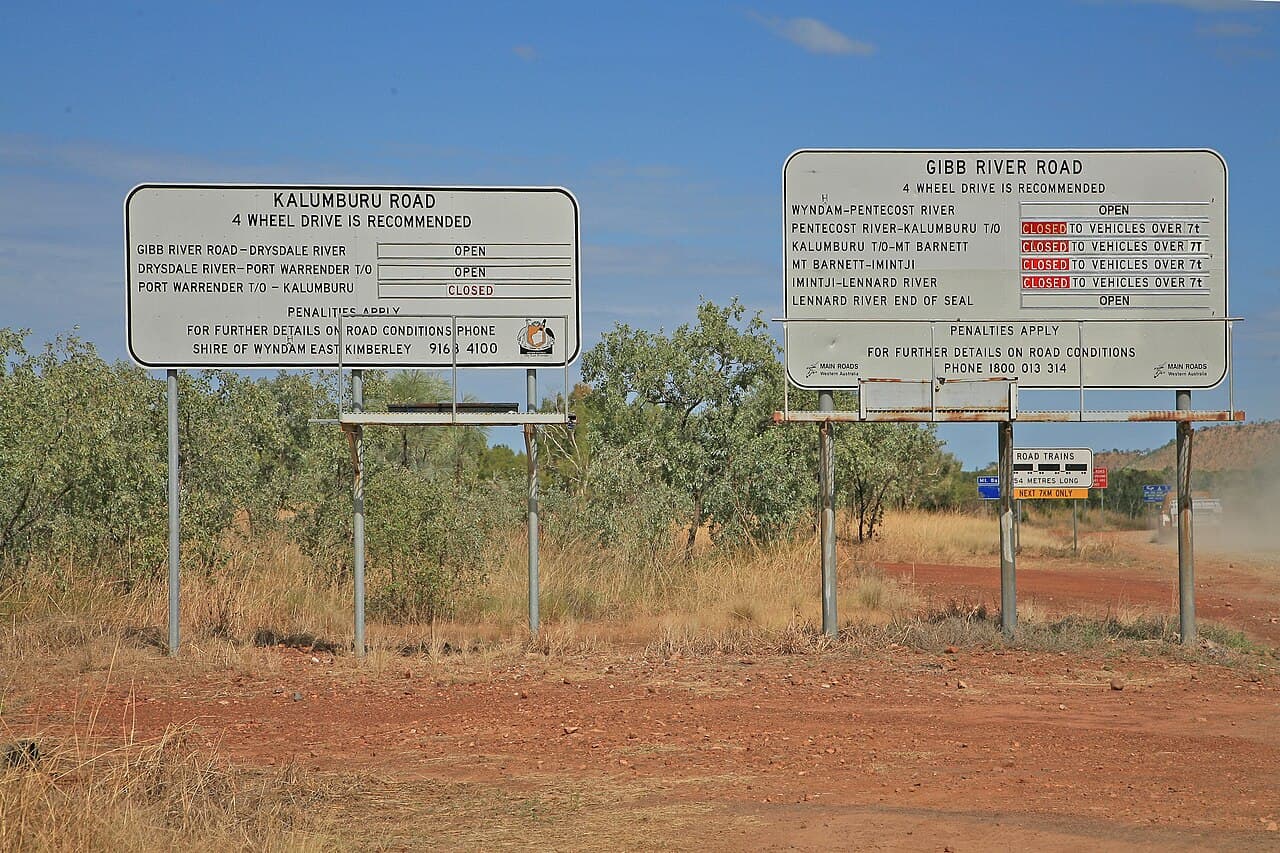
Gibb River Road, Western Australia — W. Bulach, Wikimedia Commons, CC BY-SA 4.0.
The Kimberley is a remote string of crossings and corrugations. If you have not already practised the boring skills, this is the wrong first week.
The Kimberley and Gibb River Road are not a beginners’ first remote week. They suit drivers who already pace corrugations, walk crossings, carry water and practised recovery, and will turn around when a late storm rewrites a WA parks page. Dry season is commonly discussed as mid-year; confirm DBCA and related pages. We do not invent closures or prices.
Not
First remote week
Walk
Every crossing
Dry
Confirm mid-year
The experience-level answer
If someone asks whether the Kimberley is okay for “our first real 4WD week”, the answer is no. Not because the Gibb River Road is a mythic grade, and not because a stock dual-cab is morally insufficient. The answer is no because the Kimberley is a long way from a tyre shop, a hospital, and a person who is paid to care about your pin. Distance, heat, corrugations, and crossings that change after a storm punish the driver who is still learning those skills on the day.
A first remote week belongs on a formed classroom you can abort: a desert-parks bulletin week with an exit, a High Country formed road with a rain turn-around, a beach permit weekend with a tide chart. Read outback driving, recovery basics, and packing. Practise air down and air up, boards, a strap brief, a radio check, and the sentence “we turn around” in a paddock. Then look at the Kimberley again.
What “ready” looks like on this site, without a licence we are not qualified to issue:
- You already treat official pages as the adult — DBCA / WA Parks and Wildlife Service for the park or crossing you named, plus any station or Traditional Owner rules that sit beside the road.
- You already walk a crossing you cannot see the exit of, and you have turned around at least once when the walk disagreed with the video.
- You already carry water with a late-day margin and a compressor you can find in the dark.
- You already know whether your recovery points are rated, and you have briefed a strap or placed boards without an audience.
- You already accept that a late storm can close a crossing in a season people call dry.
If those sentences are still theoretical, this is not your first remote week.
Gibb River Road is a string, not a sticker
The Gibb River Road is the public name people use for the formed remote road between Derby and Kununurra country. It is a corrugation, water, fuel-spacing, and crossing conversation. Side trips people name in public — gorges, waterfalls, and more remote northern roads such as Kalumburu-adjacent travel — are a further experience step, not a free extra on the same leave form. We will not tell you which crossings are open. We will not invent a fuel interval. We will say: treat every crossing as new, and read the DBCA or local bulletin for the dates you hold.
The WA travel leaf is the state-shaped twin. Péron sand is not a Kimberley rehearsal, though it can teach airing down. Cape York is Queensland, not a Kimberley substitute — compare experience level on Queensland, not stickers.
Dry season is a habit, not a forecast
Northern Australia’s dry season is commonly discussed as the more predictable window for the Kimberley — often spoken of as the middle of the calendar year. That is the same sentence we use for Cape York and the Top End. A late storm can still close a crossing. Wet-season travel is often a stay-home conversation because extraction becomes a helicopter. The wet season thread exists so mates who still want the photo hear a calm sentence. Use this page, then the park page.
We will not publish a start month as if we were the ranger.
Skills that are not optional here
- Outback driving — pacing, heat, night you did not pack for.
- Tread lightly — used legal lines, no new braid through a river bank, respect for Country and stations.
- Tyre pressures — corrugations and rock are not a beach number.
- Recovery basics — boards, rated points, spectators. A winch you have never used is jewellery.
- Comms and a paper plan if the phone dies. See the packing guide.
Vehicles do not grant permission. A LandCruiser with a lift can still drown in a hole you did not walk. A calm driver in an honest dual-cab on a formed dry-season Gibb is a different sentence from a first-week dare. See vehicles.
How to post a Kimberley week
On trip reports, name the DBCA page, the crossing you walked, and the turn-around you took. On tracks and parks, ask how people check a “seasonal” note that has no date — do not ask for a guarantee. The board will not host a secret hole.
If you are still choosing a first remote week, post that question with this leaf linked, and accept “not yet” as a useful answer.
What we will not specify
We will not tell you the Gibb is open. We will not publish a park fee. We will not rank a #1 Kimberley camp. We will not invent a crossing depth. We will not tell beginners they will be fine because they bought a fridge.
If you want a club or a tag-along that is actually a skills structure, do that before you treat the Kimberley as a first desert. Then post what you practised.
Ready remote week versus first remote week
| Feature | Kimberley-ready habit | First remote week |
|---|---|---|
| Skills | Already walked crossings, aired, recovered in a paddock. | Still theoretical. Choose a smaller classroom. |
| Gibb | A formed remote string you can still abort. | Not the first place to learn distance. |
| Season | Dry commonly mid-year — still confirm DBCA. | A leave form treated as a forecast. |
| Failure plan | Turn around; you are not the helicopter’s problem. | Optimism and a jewellery winch. |
Keep reading
Questions people actually ask
Is the Kimberley okay for beginners?+
No as a first remote week. The Kimberley suits drivers who already pace corrugations, walk crossings, carry practised recovery and water, and will turn around when a park page or a storm says so.
Is the Gibb River Road a beginner track?+
Treat it as a remote formed road for people who already have outback habits, not as a first-week classroom. Confirm DBCA and related pages. We do not invent a current grade or closure.
When is the Kimberley dry season?+
People commonly treat the middle of the year as the more predictable window, but a late storm can still close a crossing. Confirm WA parks pages for your dates.
What should I do instead of a first Kimberley week?+
Pick a formed classroom you can abort — a desert-parks bulletin week, High Country formed roads with a rain turn-around, or a permit beach weekend — and practise the paddock syllabus first.
If it is your first remote week, pick a smaller classroom.
Post the paddock syllabus or the Kimberley turn-around. Do not ask the board to guarantee a crossing.