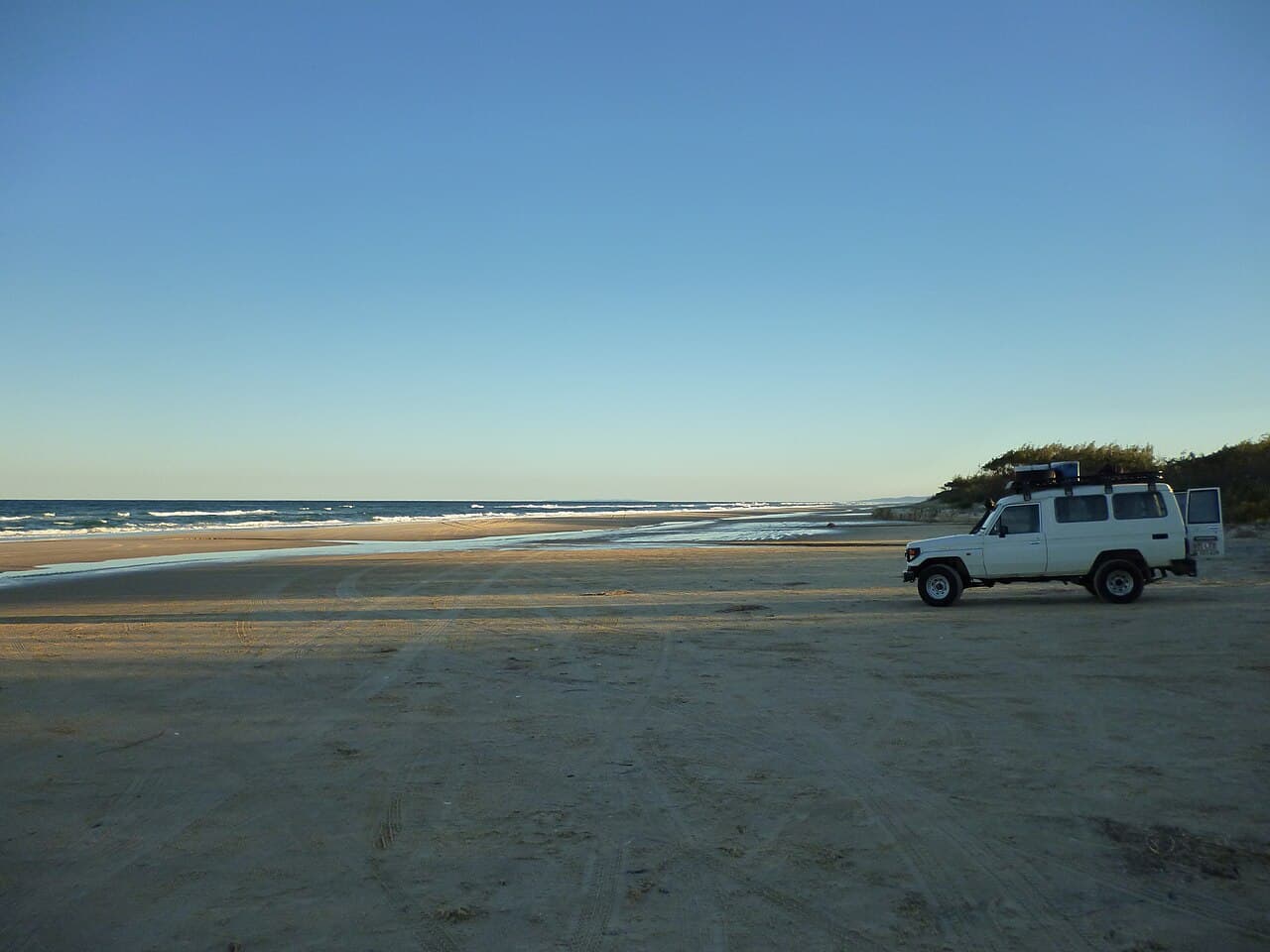
Beach driving
Rules and tips before you air down
4WD on K’gari / Fraser Island beach — Travelstine, Wikimedia Commons, CC BY-SA 4.0.
The firmer line at low tide is a habit, not a personality. Permits and the park page are the law. A braided run-up is how Inskip-style mess is born.
Australian beach driving rules start with the land manager’s permit and access page, a tide chart, and a walk of the first metres; the useful tips are air down for sand, stay on the firmer legal line, refuse to braid the approach, and air up before bitumen. K’gari, Inskip, and Péron are different classrooms. We do not invent closures, fees, or a PSI law.
Permit
Then tide
Walk
First metres
Air up
Before bitumen
The rules, in the order that keeps you invited back
Beach driving in Australia is legal only where a land manager says it is legal. That manager might be Queensland Parks and Wildlife Service on K’gari or Inskip-related recreation areas, NSW National Parks and Wildlife Service or a council on permitted coastal sands, DBCA on Shark Bay / Péron, Parks Victoria or a council on a published Victorian beach, NT Parks or a council, SA park or council pages, or Tasmanian Parks. If the page is silent, you do not drive. A fisho habit is not a permit.
Read the current page the week you travel. Vehicle access, camping, speed, pedestrians, dogs, dunes, and night driving are local. We will not invent a speed limit or a fee. We will say: the page is the rule, and tread lightly is how you still get invited back.
Marine parks, nesting seasons, and closed dune systems are not optional flavour. If a signed area is closed, that is the answer.
The tips that prevent most “recoveries”
- Tide is the boss. Hard-packed sand at the bottom of the tide is often civil. Softer shoulders near the wash are not. A rising tide is a clock. Davo’s K’gari report is the lived version: the tide chart ran the day; the rushed bit was not walking the first soft patch.
- Air down for sand, then prove it. Starting bands live on tyre pressures. Many dual-cab drivers begin lower on sand than on gravel, then adjust after walking the first metres. Load, tyre construction, and temperature change the number. Confirm with the tyre maker and your own gauge. We will not publish a magic PSI.
- Stay on the used legal line. The firmer line is usually closer to the hard pack, not a new braid through the approach or the vegetation. Inskip-style mess is a textbook of run-ups that did not need to exist. Do not add a braid to “help”.
- Walk gutters, washouts, and creek mouths. If you cannot walk it, think twice. Outback driving uses that sentence inland; it belongs on a beach too.
- Boards before drama. Most beach recoveries are pressure and line mistakes. Stop spinning. Place boards. Choose a calmer exit. Recovery basics. A snatch on a crowded beach is a spectator problem.
- Air up before the bitumen or the inland access track. Low tide on a packed beach is not a licence to stay at sand pressures on the highway home.
- Salt, night, and pedestrians. Rinse what you can when you can. Night beach driving is a local-rule and fatigue conversation. People, kids, and anglers use the same sand.
Classrooms that are not interchangeable
K’gari — QPWS vehicle and camping processes, eastern beach and inland sand, World Heritage rules. Walk the first soft patch. Do not treat a barge queue as the briefing.
Inskip — mainland beach camping and approach habits. The braided mess is the lesson you refuse to repeat.
Péron / Shark Bay — DBCA sand, different paperwork from Dirk Hartog. Wind rewrites the surface. Read WA travel.
NSW permitted sands — Worimi / Stockton-style areas when the page says so. Read NSW travel.
A suburban sand track near home can teach airing down without an audience. It cannot teach a K’gari tide. Use it as a paddock.
Victorian, SA, NT, and Tasmanian beaches follow the same rule stack: published access, local speed, pedestrians, and a tide chart. The Victoria, SA, NT, and Tasmania leaves exist so you open the right agency, not so you copy a Queensland habit onto a different sand.
Recovery and spectators on a beach
A crowded beach is a worse place to load a kinetic strap than a quiet paddock. Walk people back. Children and dogs volunteer for the worst place to stand. If someone will not move, the rope does not come tight. Boards and a calmer line still go first. Recovery basics.
Salt in a winch or a plug kit is a maintenance story you deal with after you are unstuck. We will not rank a winch. We will say: if the first time you pay out rope is on a rising tide with an audience, you do not have a winch. You have a story waiting to go wrong.
What we will not specify
We will not invent a permit price. We will not tell you a beach is open. We will not rank a #1 sand tyre. We will not publish a secret run-up.
How to post a beach week
On trip reports, name the agency, the tide, whether you walked the first patch, and whether you refused a braid. The tracks and parks board wants the page you checked. The board wants the habit.
Sibling leaves: Queensland for K’gari and Inskip; WA for Péron; High Country if someone is copying a beach PSI onto clay — do not.
Legal firmer line versus braided run-up
| Feature | Rules-and-tips habit | Highlight-reel habit |
|---|---|---|
| Permission | Published permit and access page. | A fisho story and a hope. |
| Surface | Walk first, then the firmer legal line. | A new braid through the approach. |
| Pressure | Starting band, then the sand in front of you. | A number from a video, held on the highway. |
| Unstuck | Stop spinning, boards, calmer line. | A snatch for content on a crowded beach. |
Keep reading
Questions people actually ask
What are the rules for beach driving in Australia?+
Drive only where the land manager publishes vehicle access, carry the required permit, obey local speed and dune rules, and treat closures as final. QPWS, NPWS, DBCA, and other agencies do not owe you a beach because a video exists.
What are the most useful beach driving tips?+
Use a tide chart, air down for sand, walk the first metres, stay on the firmer legal line, refuse to braid the approach, carry boards, and air up before bitumen.
What pressure should I run on the beach?+
Use a starting band from the tyre-pressures guide, then prove it on the sand in front of you. We do not publish a magic PSI. Load and tyre construction change the number.
Is Inskip or K’gari okay for a first beach trip?+
They can be public classrooms if permits, tide, and a walk-first habit come first. They are not a licence to invent a run-up. Read the QPWS page the week you travel.
Walk the first patch. Refuse the extra braid.
Post the tide and the unused strap. That is a beach report this board will keep.